Husband Henry Stephens Salt
Queer Places:
4 Ozone Terrace, Lyme Regis DT7 3JY, United Kingdom
St Michael the Archangel Churchyard, Church St, Lyme Regis DT7 3DB, United Kingdom
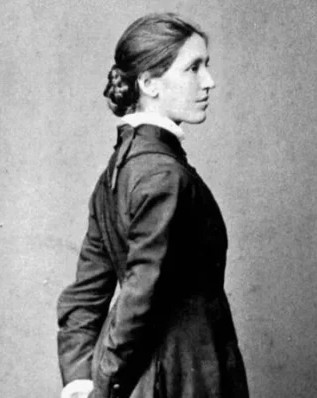 Catherine "Kate" Leigh Joynes (February 8, 1857 – February 16, 1919), later known as Catherine Leigh Salt, was born on February 8, 1857, at Eton, Buckinghamshire. She was
the fourth child of the Reverend James Leigh Joynes, an Eton College master, and Elizabeth Johanne Unger. Growing up within the traditional academic environment of Eton,
Kate was nevertheless exposed early on to unconventional ideas through her family, including her brothers James Leigh and Herman, who shared strong humanitarian and
progressive leanings.
Catherine "Kate" Leigh Joynes (February 8, 1857 – February 16, 1919), later known as Catherine Leigh Salt, was born on February 8, 1857, at Eton, Buckinghamshire. She was
the fourth child of the Reverend James Leigh Joynes, an Eton College master, and Elizabeth Johanne Unger. Growing up within the traditional academic environment of Eton,
Kate was nevertheless exposed early on to unconventional ideas through her family, including her brothers James Leigh and Herman, who shared strong humanitarian and
progressive leanings.
On December 22, 1879, she married Henry Stephens Salt at the Church of St. John the Evangelist in Eton. Henry was then a
classicist and assistant master at Eton, though he would later renounce conventional society to become a prominent writer, pacifist, vegetarian pioneer, and animal rights
campaigner. The couple initially lived a standard academic life, but under the influence of radical thinkers—accelerated by Kate’s brother James—they grew increasingly
disillusioned with Victorian institutions. By 1884, Henry resigned from Eton, and the couple moved into a modest labourer's cottage in Tilford, Surrey, embracing a simpler,
self-sustaining lifestyle rooted in voluntary simplicity, ethical vegetarianism, and social reform.
Though Kate chose not to pursue a traditional public career, she was deeply integrated into the late-19th-century radical, socialist, and labor movements alongside her
husband. She was widely recognized by her contemporaries for her extraordinary intellect, emotional intensity, and dazzling literary gifts, though she rarely published her
work outside of personal correspondence. Prominent figures of the era left striking impressions of her personality. The visionary socialist poet
Edward Carpenter described her as tall, raven-haired, highly musical, and possessing a rare, sensitive spiritual depth.
Similarly, after her death, the colonial administrator and writer Sydney Olivier remarked that Kate was one of the most astonishingly gifted personalities he had ever
encountered.
Kate and Henry's marriage was famously unconventional, matching their radical political philosophies with personal arrangements that subverted standard Victorian marital
norms. As detailed in biographical literature, including George Hendrick's Henry Salt: Humanitarian Reformer and Man of Letters (1977), their union was nonsexual, operating
as an intimate intellectual and emotional partnership rather than a conventional physical one. Within their progressive circles—which frequently intersected with early
pioneers of queer liberation and sexology, such as Edward Carpenter—alternative relationship structures were actively explored and practiced. Kate’s identity and personal
preferences aligned closely with what would modernly be understood as lesbian or queer, and her domestic life with Henry accommodated these dynamics comfortably.
Their social circle included radical free-thinkers who challenged traditional sexual morality, notably the playwright
George Bernard Shaw. Shaw maintained a close, nonsexual involvement with both Henry and Kate, integrating himself into their
household dynamic as part of a broader network of intellectual comrades who rejected conventional bourgeois family arrangements. This partnership allowed Kate the autonomy
to navigate her personal life, artistic inclinations, and deep emotional connections outside the constraints of traditional heterosexual marriage.
Kate and Henry remained deeply devoted companions for forty years, sharing a life of letters, activism, and intellectual camaraderie until her death. Kate passed away on
February 16, 1919, at La Casa in Lyme Regis, Dorset. Her death was a profound loss for Henry, who often reflected that she had brought immense spiritual richness and a
multitude of dimensions into his life.
References:
- George Hendrick, Henry Salt: Humanitarian Reformer and Man of Letters (Urbana: University of Illinois Press, 1977) — The primary biographical study detailing Henry Salt's life, his nonsexual marriage to Kate Joynes, and the close intellectual network involving George Bernard Shaw.
- Ruth Brandon, The New Women and the Old Men: Love, Sex and the Woman Question (New York: Norton, 1990), pp. 243–48 — Examines the radical marital dynamics, unconventional relationships, and social reform circles of late-Victorian figures, including the Salts.
- Edward Carpenter, My Days and Dreams: Being Autobiographical Notes (London: George Allen & Unwin, 1916) — Features contemporary recollections and descriptions of Kate Salt's personality, striking appearance, musicality, and literary brilliance.
- Sheila Rowbotham, Edward Carpenter: A Life of Liberty and Love (London: Verso, 2008) — Contains numerous references to Kate Salt and her integration into radical, socialist, and early queer-adjacent intellectual networks.
- Sydney Olivier, Sydney Olivier: Letters and Selected Writings, edited by Margaret Olivier (London: George Allen & Unwin, 1948), pp. 147–48 — Includes correspondence reflecting on Kate Salt's extraordinary intellect and dazzling literary gifts following her death in 1919.
- Wendy Parkins, Edward Carpenter’s Queer Ecology of the Everyday (London: Bloomsbury Academic) — Explores the alternative lifestyles, nonconformist domestic arrangements, and ecological/humanitarian philosophies of the Salt-Carpenter circle.
- Henry Salt, Seventy Years Among Savages (London: George Allen & Unwin, 1921) and Company I Have Kept (London: George Allen & Unwin, 1930) — Salt's autobiographical works providing context on their shared life, voluntary simplicity at Tilford, and intellectual comradeship.
- Bernard Shaw: Guide to Research, Stanley Weintraub, Penn State Press, 1 giu 1988
Support this project
This website is a passion project researched, developed, and funded entirely by me. If you find the content valuable and would like to help support the ongoing research and hosting costs, any contribution is deeply appreciated.
Thank you for keeping this independent resource alive!
My books on Amazon: Elisa Rolle's books
BACK TO HOME PAGE